A founder I advised sat down across from me and said he was shutting down his urgent care telemedicine company.
Six months earlier he’d been on stage at a health-tech pitch competition. Investors had called his deck “inspiring.” A TechCrunch writeup listed him as “one to watch.” Then a competitor launched faster. Then the competitor got the next TechCrunch article. Then the competitor raised the round he was targeting. And somewhere between the second rejection and the fourth, the story he’d been telling himself — “I’m improving access to healthcare for underserved communities” — stopped being enough.
He pivoted to crypto. I’m not making that up.
I have watched this pattern enough times that I can see it from the first conversation. The useful question is not whether someone has a good answer to “why are you building this?” It is whether that answer survives 18 months of the world saying no.
Most answers can’t. Most answers were never built to.
Every January, millions of people set ambitious goals. By February, 80% have abandoned them. The usual explanation is willpower, discipline, or commitment — personal failings to blame yourself for. But the real problem is structural: most people are operating from the wrong level of motivation, on foundations that collapse under real pressure.
Over the past decade working with entrepreneurs, clinicians, and operators, I’ve watched who sustains through multi-year challenges and who burns out in months. The difference isn’t talent, opportunity, or resources. It’s the depth of their “why” — the psychological foundation driving their work. Not all whys are created equal.
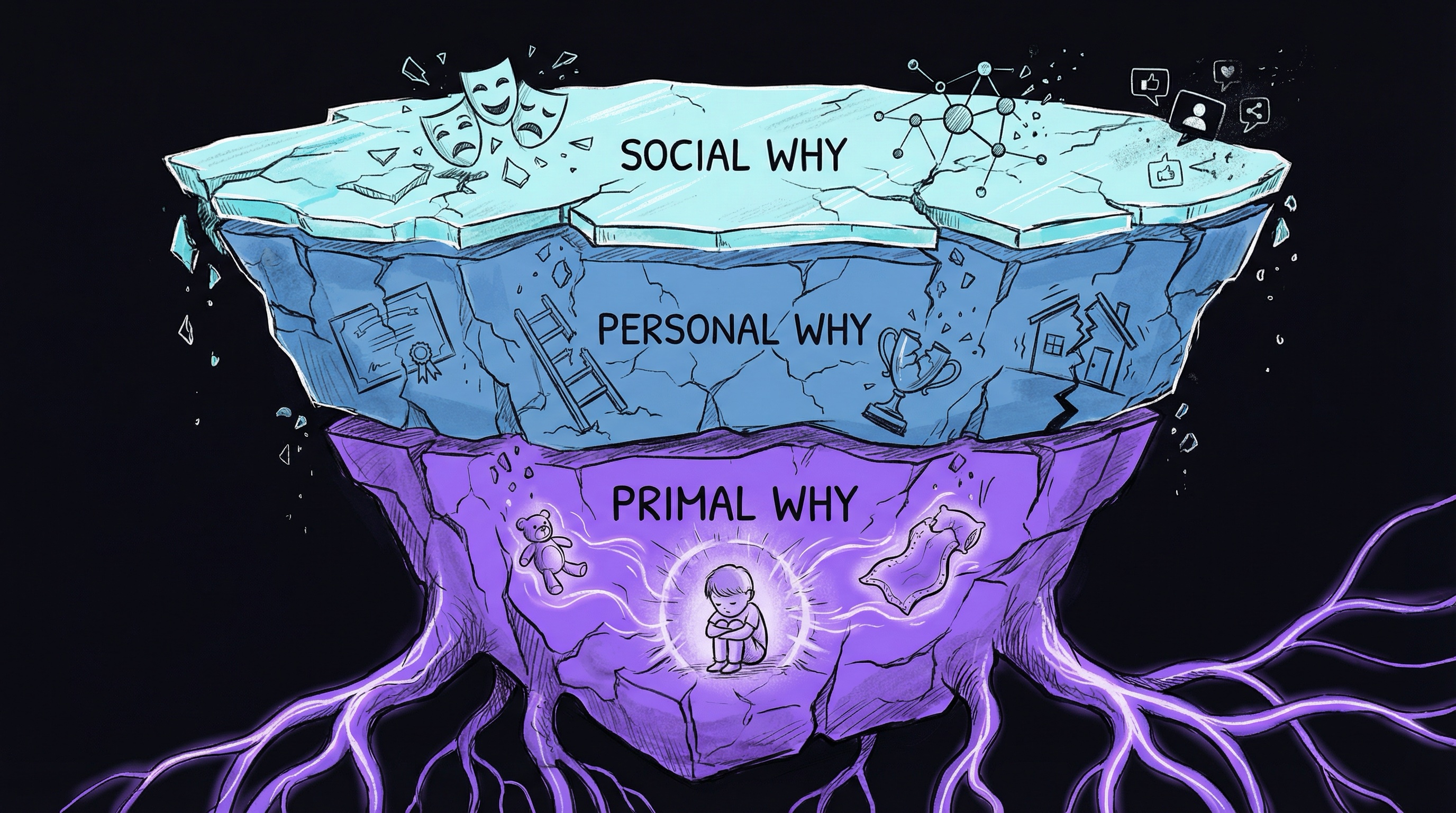
Three kinds of why
There are three levels, and they fail differently under stress. This is not about sincerity. People at every level believe what they say. The difference shows up when the world pushes back.
The social why
This is the answer you give at networking events. “I’m building this to disrupt healthcare.” “I want to make a difference.” “I’m passionate about innovation.”
These aren’t lies. They’re just incomplete — socially acceptable narratives you’ve constructed to explain your choices to others. They sound good because they’re designed to.
Durability: 3–6 months under moderate stress. Collapses immediately when you face serious social rejection — the kind where people whose opinion you care about tell you, explicitly or implicitly, that what you’re doing doesn’t matter.
Recognition pattern: If you need external validation to continue, you’re operating from a social why. If bad press, investor rejection, or criticism from peers makes you question the entire endeavor, this is your level.
Real example: That founder I mentioned — building an urgent care telemedicine platform. His social why was “improving access to healthcare for underserved communities.” Noble. True. But when competitors launched faster and TechCrunch wrote about them instead of him, he spiraled. He couldn’t explain why he should keep going when others were already solving the problem. Six months later: crypto.
The social why works great when things are going well. It generates compelling pitch decks and inspiring LinkedIn posts. But it’s built on external validation — the approval of other people — and external validation is unstable fuel. You can’t control it, you can’t predict it, and it runs out exactly when you need it most.
The personal why
This is what you tell yourself. Your actual conscious reasons.
“I watched my grandmother die in an emergency room waiting six hours for care. I’m fixing this so no one else goes through that.” This is real. This is powerful. This is still not enough.
Durability: 12–18 months under sustained pressure. Can survive some rejection but eventually fractures — not all at once, but in hairline cracks that spread until the structure gives.
Recognition pattern: If you need the work to succeed for the why to feel valid, you’re on this level. If failure would mean “it was all for nothing,” you’re here. The personal why is outcome-dependent — it needs the world to eventually say yes.
Real example: A physician founder lost his father to a preventable medical error. His personal why was eliminating diagnostic mistakes through AI — a system that catches what human clinicians miss. After 18 months of rejected funding rounds, failed pilot programs, and hospitals saying “we’re not ready for this,” he couldn’t sustain it. The rejection didn’t just block the work. It felt like the universe saying his father’s death didn’t matter enough to change the system.
He returned to clinical practice. I don’t blame him. His why was real — it just wasn’t durable enough for the timeline the problem demanded.
The personal why is substantially more durable than the social why. It can carry you through investor rejection, failed launches, and even some financial hardship. But when the world repeatedly tells you no, the personal why starts asking a question it can’t answer: “Maybe I’m wrong. Maybe this isn’t actually important enough.”
That question is corrosive because the personal why has no defense against it. It needs external confirmation — some signal that the sacrifice is worth it — and when that signal doesn’t come, it dissolves.
The primal why
This is the motivation that wakes you up at 3 AM and won’t let you sleep.
It’s not rational. It’s often not something you chose. It’s the psychological wound or void that drives you whether the project succeeds or fails — motivation that exists independent of outcomes.
Durability: Indefinite. Can sustain 18+ month rejection cycles, multiple failures, and complete external skepticism. I’ve watched people operate on this for decades.
Recognition pattern: If you would do this work even if it was guaranteed to fail — if the act of trying meets a psychological need independent of the result — you’ve found your primal why.
Steve Jobs captured this in a 1994 interview: “I’m one of those people that think that Thomas Edison did a lot more to improve the world than Karl Marx and Nikos Kazantzakis put together. I’m one of those people that thinks that creation is the highest form of human activity, and that’s it.”
He didn’t say “if it succeeds.” He said creation itself. The primal why doesn’t require external validation because it’s answering an internal psychological imperative — a command from somewhere deeper than conscious reasoning.
What the research found
A 2019 University of Pennsylvania study of 478 successful entrepreneurs found that 78% reported experiencing significant childhood powerlessness — poverty, parental inconsistency, health crises, family instability, or early responsibility beyond their developmental capacity.
The researchers identified what they called “compensatory drive” — a psychological need to create control, stability, or proof of capability that persists regardless of actual achievement. These entrepreneurs built companies not primarily to create value or make money. They built them to answer an internal question formed in childhood: “Am I capable? Can I create safety? Can I prove I’m not powerless?”
This is not trauma glorification. It is pattern recognition. The study found that entrepreneurs with compensatory drive were 3.2x more likely to persist through 18+ month rejection cycles, 2.1x more likely to restart after total failure, and 4.7x more likely to report that “stopping feels harder than continuing.”
Why? Because external rejection doesn’t answer the question the primal why is asking. Investor rejection doesn’t answer “Am I capable?” Failed launches don’t answer “Can I create control?” The primal why sustains because it exists independently of outcomes — it’s a question the world can’t answer, so the world can’t shut it down.
Eighteen months at the table
In private equity and healthcare acquisitions, 18 months is the standard cycle for serious deals. You identify a target, build relationships, conduct due diligence — the formal investigation of a company’s financials, legal standing, and operations before purchase — negotiate terms, secure financing, navigate regulatory approval, and close. At any point, the deal can collapse.
It usually does. More than once.
I’ve watched dozens of acquisition teams through these cycles. The pattern is consistent enough that I can now predict who’ll still be at the table at month 16 and who’ll have quietly moved on.
In months 1–3, everyone is motivated. The social and personal whys are firing, the deal makes strategic sense, and the team’s story about why it matters is compelling.
Months 4–8 bring the first major rejection. Financing falls through, the target’s board says no, or a government agency delays approval of the deal structure. The social why starts to fracture. Team members who were there for a resume line or a learning experience explore other opportunities. They are not wrong to leave; they have shown which level they were operating from.
Months 9–14 bring multiple rejections. The personal why is under assault: “Is this actually worth it? Am I wasting time? Should I be doing something else?” The people who stay are operating mostly from a primal why, whether they have named it or not.
By months 15–18+, only the primal why remains. The people still at the table aren’t there because the deal makes strategic sense. Walking away would violate something deeper: the need to finish, prove capability, or create an outcome that compensates for a wound formed decades earlier.
This isn’t always healthy. I want to be clear about that. Operating from an unexamined primal wound can drive you into the ground. But it’s powerful. And it’s the difference between teams that close complex deals and teams that don’t.
Finding your primal why
Most people have never done this introspection. They operate from social why or personal why and wonder why motivation fluctuates — why some mornings they’re on fire and other mornings they can’t remember why they started.
Here’s the framework I use.
Ask why five times
Ask yourself why you’re doing the work. Then ask “why does that matter?” five times. Each answer becomes the input for the next question. Most people stop at layer two or three because the answers get uncomfortable.
For example:
- “Why am I building this urgent care scheduling system?” — “To reduce patient wait times.”
- “Why does reducing wait times matter to you?” — “Because I’ve seen patients leave before being seen and end up in the emergency room.”
- “Why does that bother you specifically?” — “Because it’s preventable suffering.”
- “Why do you need to prevent that suffering?” — “Because someone should. Because it’s fixable.”
- “Why do you need to be the one to fix it?” — “Because if I don’t, I’m complicit. Because I can’t look at a solvable problem and do nothing.”
That last answer is closer to primal. It’s about self-concept, not outcomes. “I can’t be the person who sees this and does nothing” is primal. “Patients deserve better care” is personal — still true, still real, but dependent on the world validating that truth.
Ask the 3 AM question
If you woke up at 3 AM and knew with certainty that your project would fail — zero chance of success — but you could keep working on it anyway, would you?
If yes: why? That reason is primal.
If no: you’re operating from personal or social why. That’s fine for projects that can succeed within 12 months. It’s not enough for longer campaigns.
Look at the childhood wound
This is uncomfortable. It’s also essential.
What situation in your childhood made you feel powerless, invisible, or inadequate?
Now ask: how does your current work address that wound?
The founder building telemedicine who grew up rural with no access to doctors. The operator obsessed with efficiency who grew up in chaos and couldn’t control anything. The entrepreneur proving business acumen who was told they’d never amount to anything.
The primal why is often the adult capable response to the childhood powerless situation. You’re building what you needed then. You’re proving what you couldn’t prove then. You’re creating the control you didn’t have then.
My Primal Why: The Integration of Two Events
I can give you the social why for my work in healthcare AI and urgent care operations: “I want to improve patient access and reduce clinician burnout.”
I can give you the personal why: “I’ve seen broken systems waste human potential and I know technology can fix this.”
Both true. Both insufficient.
My primal why comes from two specific events I don’t talk about publicly much.
First: In 2019, I was hiking Mount Emei in China and got severe altitude sickness — a condition where the air is too thin for your body to get enough oxygen. I was hours from medical care, unable to breathe properly, genuinely uncertain if I’d survive the descent. The psychological experience wasn’t fear of death. It was rage at the arbitrariness. “I might die because I’m in the wrong place at the wrong time and there’s no system to help.”
Second: My wife and I lost a pregnancy in 2020. The medical system was clinically competent but operationally indifferent. Appointments were hard to schedule. Results took days. No one communicated proactively — we had to chase every piece of information. The loss was hard. The bureaucratic indifference — the sense that we were items in a workflow rather than people in a crisis — made it worse.
Those two experiences — the personal encounter with system absence and the personal encounter with system indifference — are why I work on urgent care access and healthcare operations. Not because I think it’s a good market, though it is. Not because I’m passionate about healthcare, though I am. Because I cannot be the person who experienced those things and didn’t try to build systems that would have helped.
That’s primal. It persists regardless of outcomes. If every urgent care telemedicine company I build fails, I’ll still be working on this in some form. Because not working on it would violate my self-concept as someone who responds to experienced injustice with capability.
Why sacrifice feels different
Jordan Peterson talks extensively about the relationship between sacrifice and meaning. His core insight: you value what you sacrifice for, not what you get easily.
The primal why is the psychological foundation that makes deep sacrifice possible. You can’t sacrifice years of your life for a social why — it’s too unstable, too dependent on whether other people applaud. You can sacrifice some for a personal why, but it’s fragile — it cracks when the world says no enough times. The primal why makes sacrifice psychologically necessary, which means it doesn’t feel optional.
When you’re operating from primal motivation, sacrifice doesn’t feel like loss. It feels like integrity — alignment between your actions and your deepest self-concept. Choosing the hard path isn’t a cost. It’s proof that you’re the person you need to be.
This is why entrepreneurs with primal why often describe their hardest years as their most meaningful. Not because suffering is good. Because the suffering was in service of something that defined their identity. The sacrifice validated the why rather than depleting it.
I got this wrong for years. I thought meaning came from achieving something. It doesn’t. Meaning comes from carrying something.
When the primal why goes wrong
This framework is descriptive, not prescriptive. Having a primal why doesn’t make you right. It makes you durable. And durability applied to the wrong goal is destructive.
The warning signs:
-
You can’t stop even when the evidence is overwhelming that you should. Primal why makes it hard to quit. That’s useful for 18-month rejection cycles. It’s pathological when applied to fundamentally doomed pursuits — when the problem isn’t that the world hasn’t recognized your genius yet, but that your approach genuinely doesn’t work.
-
You’re optimizing for psychological compensation, not actual outcomes. If you’re building something primarily to prove a point to your childhood self, you may be solving the wrong problem — the one that salves your wound rather than the one that creates real value.
-
You’re sacrificing relationships, health, or ethics. Primal why can sustain you through hardship. It doesn’t justify destroying yourself or others. I’ve watched founders burn marriages and friendships in service of proving something to a parent who died years ago. The primal why wasn’t the problem. The lack of self-awareness about it was.
If your primal motivation is driving you toward burnout, you don’t need more grit. You need therapy. The primal why should be a foundation for sustainable high performance, not an excuse for self-destruction.
If the work will last 18 months
Find the primal why before you start. If you cannot find one, the project is too ambitious for your current foundation; scale down or choose another problem. There is no shame in work that fits your current why. The waste is committing to work that will outlast it.
Be honest about the level you are using. Social or personal motivation is fine, but do not commit to a multi-year campaign from that foundation. You’ll burn out, and it will feel like personal failure when the problem was structural.
Build a team with compatible primal whys. The wounds do not need to match, but they need to drive people toward the same solution. Mismatched primal motivations create team dysfunction under stress: when one person needs to prove capability to a critical parent and another needs to create safety after an unstable childhood, the same strategic decision can satisfy one and violate the other.
Use the primal why when making hard choices. Ask, “Which option serves the primal why?” If neither option does, the work has drifted from what makes it sustainable.
Return to the why when motivation wanes. Social motivation fades when applause stops. Personal motivation fractures after enough rejection. Primal motivation lasts, but it still needs deliberate reconnection.
Match the why to the work
Social or personal motivation can carry a new skill, a reading goal, or a side project. Building a company through 18+ month rejection cycles, pursuing a career pivot that requires years of preparation, or solving a problem most people think is impossible requires a deeper foundation than the version of yourself that shows up to networking events.
That is the primal why: the motivation that remains at 3 AM when no one is watching and nothing is working, rooted in a transformed childhood wound and independent of whether the work succeeds or fails.
Further Reading
- Man’s Search for Meaning by Viktor Frankl — The foundational text on meaning-driven motivation, written by a psychiatrist who survived Auschwitz and observed who did and didn’t make it
- The Denial of Death by Ernest Becker — On how childhood experiences shape adult drives, and why we build entire lives to manage the terror of mortality
- 12 Rules for Life by Jordan Peterson — Particularly Rule 7: “Pursue what is meaningful (not what is expedient)”
- Shoe Dog by Phil Knight — A case study of primal why sustaining through decades of rejection; Nike almost died more times than most companies exist
- Originals by Adam Grant — Research on what drives sustained contrarian effort, and why the people who change things are rarely the ones who look like they should