I spent six months building a personal AI operating system — a thing I call PAI — that nobody asked me to build. When it finally worked, when the agents stayed alive across sessions and the memory persisted and the infrastructure hummed, I sat in front of my terminal at 11pm and felt nothing. No satisfaction. No relief. Just the quiet question I’d been avoiding: what was that for?
I found the Jordan Peterson clip the next day. I don’t remember what I was searching for. I do remember that he said something I’d been feeling for months but had never been able to name: the question isn’t “what makes you happy?” It’s “what burden are you willing to carry?”
I had carried a burden for six months — the daily discipline of building and maintaining a system that serves me but also owns me — and the carrying itself, not the completion, was what had kept me going. The moment the burden lifted, so did the meaning.
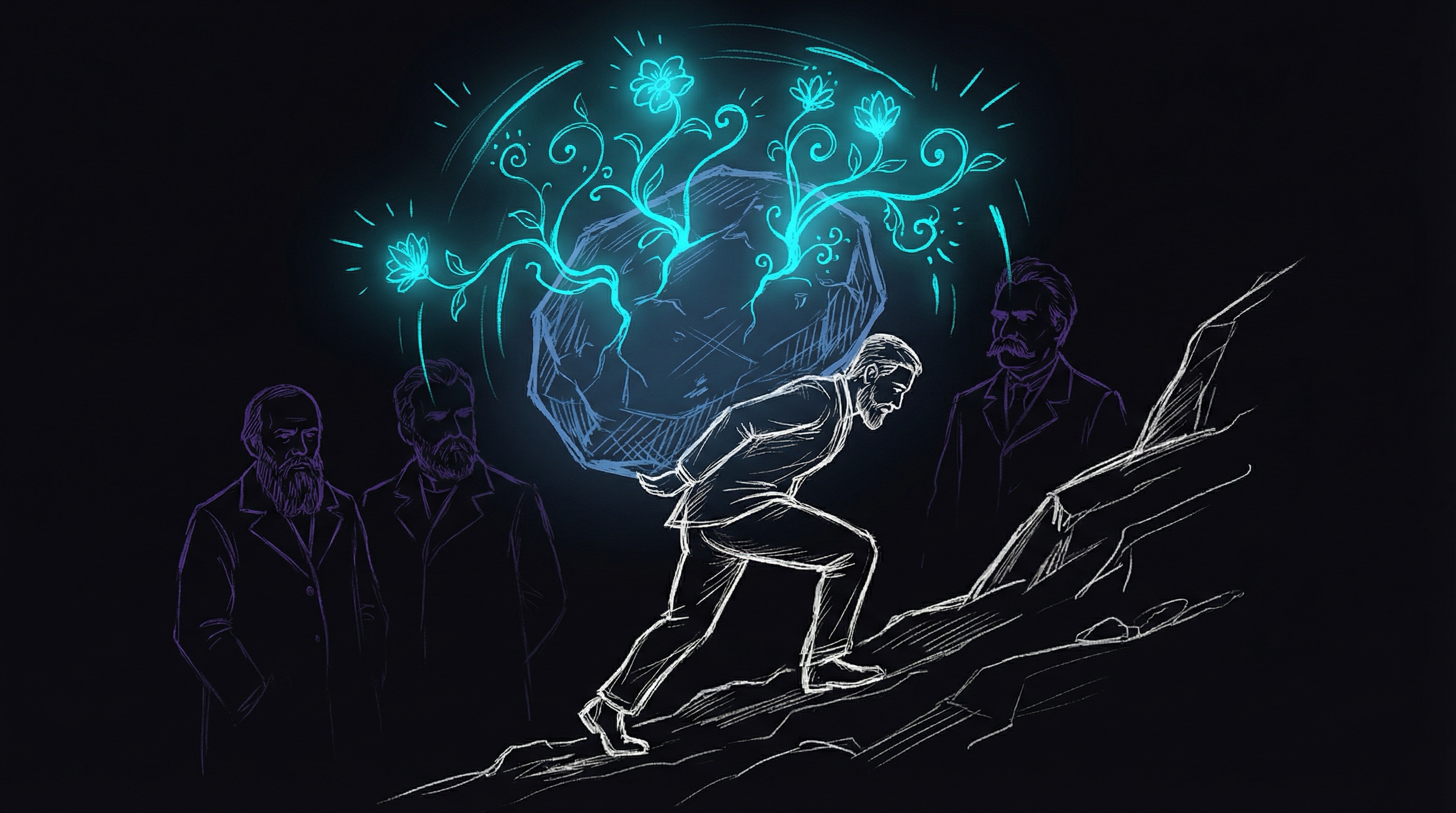
Peterson argues this is bigger than my own story. And the reframing — from happiness-seeking to responsibility-accepting — is the most useful way I’ve found to think about the problem.
The question I had been asking was too small
Our culture runs on optimization. We optimize our diets, our sleep, our productivity stacks, our relationships. The assumption baked into all of it is that if we just dial in the formula, we hit a stable state of contentment and stay there.
Peterson, drawing on existentialist philosophy — a school of thought that starts from the fact that you exist as an individual in a universe that didn’t ask your permission — and his own clinical psychology practice, says this whole framework runs backward.
“It’s in responsibility that most people find the meaning that sustains them through life.”
This isn’t a moral prescription. It’s a pattern he observed across thousands of patient hours. His patients’ depression and anxiety didn’t correlate with how comfortable their lives looked on paper. People with objectively easy lives would be paralyzed by meaninglessness — nothing felt like it mattered, because nothing was asked of them. People carrying genuine hardship — illness, loss, grinding obligation — would demonstrate resilience that didn’t make sense if circumstances determined wellbeing.
The difference was never the circumstances. It was whether they felt they were carrying a meaningful burden.
I got this wrong the first time I heard it. I heard “suffering is good for you” — a bootstrap morality dressed up as psychology. That’s not what he’s saying. He’s saying meaning and burden are the same thing seen from different angles, and if you try to have the first without the second, you get neither.
Distress is part of the deal
The existentialists — philosophers who took seriously the fact that you’re a conscious being who didn’t choose to be one — understood something modern psychology tends to forget.
Consciousness itself is a burden. Self-awareness means you know you’ll die. You know you’ll fail, repeatedly. You know that entropy increases and everything deteriorates — your body, your relationships, your work, everything. These aren’t cognitive distortions you can therapy away — the kind of distorted thinking cognitive behavioral therapy targets. They’re structural features of being conscious.
Heidegger called this “thrownness” — you didn’t ask to exist, but here you are, dropped into a world you didn’t design, forced to make choices without adequate information and no do-overs. Sartre pushed it further: freedom itself is a burden, because it means you’re responsible for what you become — there’s no cosmic plan to blame when things go wrong. Kierkegaard described the “dizziness of freedom” — the vertigo of realizing you could do anything, which makes it paradoxically harder to actually do something.
Peterson synthesizes this into a practical baseline: distress is the default state. The question isn’t how to eliminate it. It’s what you’re willing to endure it for.
This is why the “just reduce your stress” advice so often backfires.
It operates on the assumption that if you remove enough stressors, you’ll be fine. But the existential stressors — the ones built into having a mind — can’t be reduced. They’re not optional features you can disable. What you need isn’t less stress. It’s stress in service of something you chose to carry.
I learned this building PAI. The system’s complexity didn’t decrease over time — if anything, it grew. But the weight felt different once I stopped resenting it and started treating it as the thing I’d signed up for.
When the old answer disappears
Nietzsche’s line “God is dead” isn’t the atheist victory lap people treat it as. It’s a diagnosis — and a terrified one.
For thousands of years, religious frameworks provided a pre-packaged answer to the meaning question — the question of why your suffering has purpose and your actions matter. Your suffering had purpose because God had a plan. Your responsibilities were clear because they were divinely ordained — handed down, not chosen. Your actions mattered because they carried eternal consequences.
When that framework collapsed — not through rational debate but through slow cultural drift, the kind of erosion you don’t notice until the ground is gone — it left a vacuum. Nietzsche saw what was coming and it scared him. Without the religious structure, he predicted, people would split into two groups. Some would retreat into nihilism — the belief that nothing has inherent meaning, so nothing matters. Others would try to fill the void with political ideologies, eventually leading to totalitarianism — systems where the state provides the meaning that religion used to.
His solution is direct: if there are no pre-existing values, you have to create your own. The Übermensch — the “overman” or “superman,” though neither translation quite works — isn’t a superior person who dominates others. It’s someone who can bear the weight of self-created meaning without collapsing into nihilism or grabbing for authoritarian certainty. Someone who can stand in the void and build anyway.
Dostoevsky’s objection
Dostoevsky came at the same problem from the opposite side.
In The Brothers Karamazov, he explored whether morality could survive without God. His answer was essentially “no — but the attempt to live as if it could is what makes us human.”
The Grand Inquisitor chapter puts the argument in its starkest form. The Inquisitor confronts a returned Christ and makes his case: most people don’t want freedom. They want security, certainty, and someone to tell them what to do. Christ offers freedom and responsibility — the terrifying adult version of faith. The Inquisitor offers bread and obedience. The Inquisitor’s argument lands hard because he’s not wrong — people demonstrably do prefer comfortable submission to burdensome freedom.
Dostoevsky’s characters who abandon God don’t transform into enlightened rationalists. They become monsters — Raskolnikov, who murders and then unravels — or paralyzed intellectuals like Ivan, who can think his way to every conclusion and act on none of them. His implicit argument: you can’t derive meaning from pure reason. You need something transcendent — something beyond what logic alone can justify — even if you can’t rationally prove it.
Peterson’s synthesis takes Dostoevsky’s insight about the necessity of transcendent meaning and marries it to Nietzsche’s insight about the necessity of self-created values. You need a transcendent narrative — a story about why your life matters — but you have to choose it voluntarily. It can’t be imposed from outside.
I think this is the part people miss when they argue about Peterson. He’s not saying “adopt my narrative.” He’s saying “pick one you’re willing to carry, and honor it.”
What you put against suffering
“What you put up against suffering is meaning.”
This is Peterson’s central claim, and I had to sit with it for a while before it landed.
He’s not saying suffering is optional if you find the right meaning. Suffering is inevitable — consciousness guarantees it. The question is whether you meet that suffering with something that makes it bearable.
The paradox is that meaning doesn’t come from reducing suffering. It comes from taking on additional voluntary suffering in service of something you value. This is the logic of sacrifice that shows up across cultures, across eras, independent of religion: you give up something now for something you value more later.
The immigrant who works three jobs to put kids through college isn’t delusional. They’re not happy in the moment — nobody working a double shift is. But they have something to put up against the suffering. That transforms meaningless pain into meaningful sacrifice.
The alternative — optimizing for comfort, avoiding all unnecessary burden, pursuing happiness directly — doesn’t lead to happiness. It leads to fragility. When you haven’t practiced carrying weight, you have no psychological structure to process it when inevitable suffering arrives — the death of someone you love, illness, failure. And it will arrive.
The practical version
Peterson’s practical framework is four ideas: life is suffering — the Buddhist first noble truth, the existentialist’s thrownness, and the thing everyone knows and most people spend their lives avoiding; meaning is the antidote, not happiness, comfort, or security; responsibility is the main source of that meaning, not pleasure, status, or achievement; and the move is to voluntarily accept the largest responsibility you can bear.
This is why “find your passion” is genuinely bad advice. Passion is ephemeral — it shows up when it wants and leaves without warning. Responsibility is structural — it’s there whether you feel like it or not. The question isn’t what excites you in a given moment. It’s what burden you’re willing to carry when excitement is nowhere in sight.
For the parent, it’s the burden of shaping another consciousness — a human being who will carry your influence, for better or worse, into a future you won’t see. For the entrepreneur, it’s the burden of creating value where none existed. For the scientist, it’s incrementally pushing back ignorance. For the soldier, it’s protecting others at potential cost to yourself.
The specific domain doesn’t matter. What matters is that you’ve voluntarily accepted that the burden is yours to carry, and that carrying it well is how you orient yourself in a universe that genuinely doesn’t care whether you exist.
Where I push back
But here’s where I think the critique matters.
Peterson’s emphasis on individual responsibility can veer into what sociologists call atomistic individualism — the idea that all outcomes are purely the result of individual choices, ignoring structural constraints that are real and unequally distributed.
“Clean your room before you criticize the world” is a good heuristic — a rule of thumb for not outsourcing your problems. But it can also be interpreted as: all problems are character problems. If you’re poor, you’re not responsible enough. If you’re depressed, you haven’t accepted enough responsibility. If you’re oppressed, you haven’t stood up for yourself sufficiently.
This isn’t just philosophically suspect. It’s psychologically damaging. It converts structural problems — systems, history, inequality — into personal failings. The person born into generational poverty doesn’t have the same capacity to “bear responsibility” as someone with inherited wealth and social capital. Telling them their suffering comes from not taking on enough responsibility is adding moral injury to material deprivation.
I sat with this tension for a long time. You can’t just hand-wave it away.
Both things can be true
The corrective isn’t to abandon individual responsibility. It’s to recognize that responsibility operates at multiple scales simultaneously.
You’re responsible for how you respond to your circumstances — but not for the circumstances themselves. You’re responsible for developing your capabilities — but not for the initial distribution of capability that you were handed at birth. You’re responsible for making the best of your situation — but that doesn’t mean the situation is just.
The existentialists actually understood this better than Peterson sometimes gives them credit for. Sartre’s concept of “being-in-situation” captures it cleanly: you’re free, but your freedom is always situated within constraints you didn’t choose. Your responsibility is to your freedom within those constraints, not to the constraints themselves.
And this matters: part of taking responsibility for your own life can mean working to change structural conditions that make responsibility harder for others. The immigrant who works to give their children opportunities is taking individual responsibility. The civil rights activist who works to remove barriers so others can take responsibility for their lives is doing the same thing at a different scale. The form is different. The pattern is identical.
What responsibility looks like
In practice, taking on responsibility doesn’t mean becoming a martyr or a workaholic. It means making a choice about what you’re willing to be responsible for, and then structuring your life around that choice.
For some people, it’s raising children well. For others, it’s building a business that employs people. For others, it’s teaching, or healing, or creating art that shifts how people see the world. The specific form doesn’t matter — the commitment does.
What matters is that you’ve made a commitment and you honor it even when it’s difficult. Especially when it’s difficult.
This is different from ambition. Ambition says “I want to achieve X.” Responsibility says “I’m willing to carry the burden of Y.” Ambition focuses on outcomes — the thing you get at the end. Responsibility focuses on process and commitment — the thing you do every day, whether anyone sees it or not.
The people I’ve known who seem most resilient, most psychologically integrated, most capable of weathering genuine hardship — they’re not the ones with the easiest lives.
They’re the ones who’ve found something they consider worth suffering for.
The test
How do you know if you’ve found a meaningful responsibility? Peterson offers a test so simple it’s easy to dismiss: Does thinking about it make your life feel heavier or lighter?
If the thought of your responsibility makes your life feel oppressively heavy — crushing, draining, something you dread — you’re probably carrying the wrong burden. Or carrying it badly. Or it was never actually voluntary to begin with. This is just suffering.
If the thought of your responsibility makes your life feel purposefully heavy — like you’re carrying something difficult but worthwhile, like a pack you chose to pick up — that’s meaningful burden. The weight is real. But it’s not oppressive.
And here’s the counterintuitive part: accepting that weight often makes life feel lighter overall. Not because the weight disappears — it doesn’t. Because you stop wasting energy avoiding it, or resenting it, or pretending it doesn’t exist. You stop fighting the thing you’re already carrying.
I noticed this with PAI. The moment I stopped resenting the maintenance burden — the breakage, the overnight crash, the endless edge cases — and accepted it as the thing I’d chosen to carry, it stopped feeling heavy in the wrong way. Still work. Still hard. But the weight had a reason.
Responsibility inside real constraints
Modern culture’s answer to the meaning crisis has largely been to deny there’s a problem.
We’re told to pursue happiness, optimize our lives, practice self-care, manifest our desires. These aren’t wrong exactly. They’re just insufficient. They don’t address the fundamental existential problem: consciousness itself is burdensome, suffering is inevitable, and you need something to make that bearable.
Peterson’s framework — that responsibility is the antidote — matches observed reality in a way that’s hard to argue with. People with tremendous responsibility often report high life satisfaction. People with minimal responsibility often report meaninglessness. This holds across cultures, across socioeconomic levels, across personality types.
The framework only works if individual agency and structural constraints are both real. You can choose how to respond to your circumstances, but those circumstances aren’t equally distributed or equally fair. Meaning comes from taking maximum responsibility within your actual situation, not an idealized one.
The danger of overemphasizing individual responsibility is that it becomes victim-blaming. The danger of overemphasizing structural constraints is that it becomes learned helplessness — the belief that since the system is rigged, nothing you do matters. The psychologically healthy position holds both: acknowledge the constraints, take responsibility for what’s actually within your control, and work to expand what’s controllable for yourself and others.
The wager
Taking responsibility in response to nihilism is a bet. You’re wagering that meaning created through voluntary commitment is sufficient to make life bearable, even without cosmic reassurance that it “really” matters.
Kierkegaard called this the leap of faith — you can’t rationally prove that your commitments are objectively meaningful, so you choose to live as if they are, and discover that the living-as-if creates its own justification.
This is different from delusion. You’re not pretending the universe cares about your projects. You’re recognizing that your caring about them is what makes them meaningful, and that this self-created meaning is the only kind available to conscious beings who can see through cosmic narratives.
You don’t get a guarantee. You get a choice.
If you want to try it
Ask what responsibility you can voluntarily accept that would make life feel purposefully heavy instead of arbitrarily burdensome. If you are depressed and directionless, start with the smallest responsibility you can honor: care for a plant, show up for a friend, or finish one small project. Build from there; the capacity grows with use. If global problems overwhelm you, work at the scale where your actions land. You can’t fix climate change, but you can improve your household’s sustainability. You can’t eliminate poverty, but you can hire responsibly or support organizations that work.
If you are successful but unfulfilled, ask whether your achievements came from responsibility or ambition. Achievement without responsibility does not generate meaning; it produces résumé lines. Find the burden you are actually willing to carry, not the one that looks good. If you are burned out, separate responsibility you chose from burden imposed from outside. Real responsibility sustains you. Imposed obligation drains you. Sometimes the responsible move is to drop false responsibilities you never chose.
Why I still carry PAI
Peterson’s synthesis won’t satisfy everyone. It doesn’t provide cosmic reassurance, promise that suffering has objective purpose, or solve the problem of evil or the apparent absurdity of existence. It offers a way to live with those problems instead of being paralyzed by them: voluntarily carry a burden you’ve chosen, in service of something you’ve decided matters, even though the universe doesn’t care either way.
That capacity might be the closest thing I know to an antidote. For a lot of people — including me, staring at my terminal at 11pm after six months building something nobody asked for — it turns out to be enough.
Further Reading
- 12 Rules for Life and Beyond Order by Jordan Peterson — Full development of the responsibility framework
- Man’s Search for Meaning by Viktor Frankl — Finding meaning in extreme suffering
- The Denial of Death by Ernest Becker — How we create meaning to cope with mortality
- Either/Or by Søren Kierkegaard — The nature of choice and commitment
- The Brothers Karamazov by Fyodor Dostoevsky — The meaning crisis in its rawest form
- The Gay Science by Friedrich Nietzsche — The death of God and what comes after